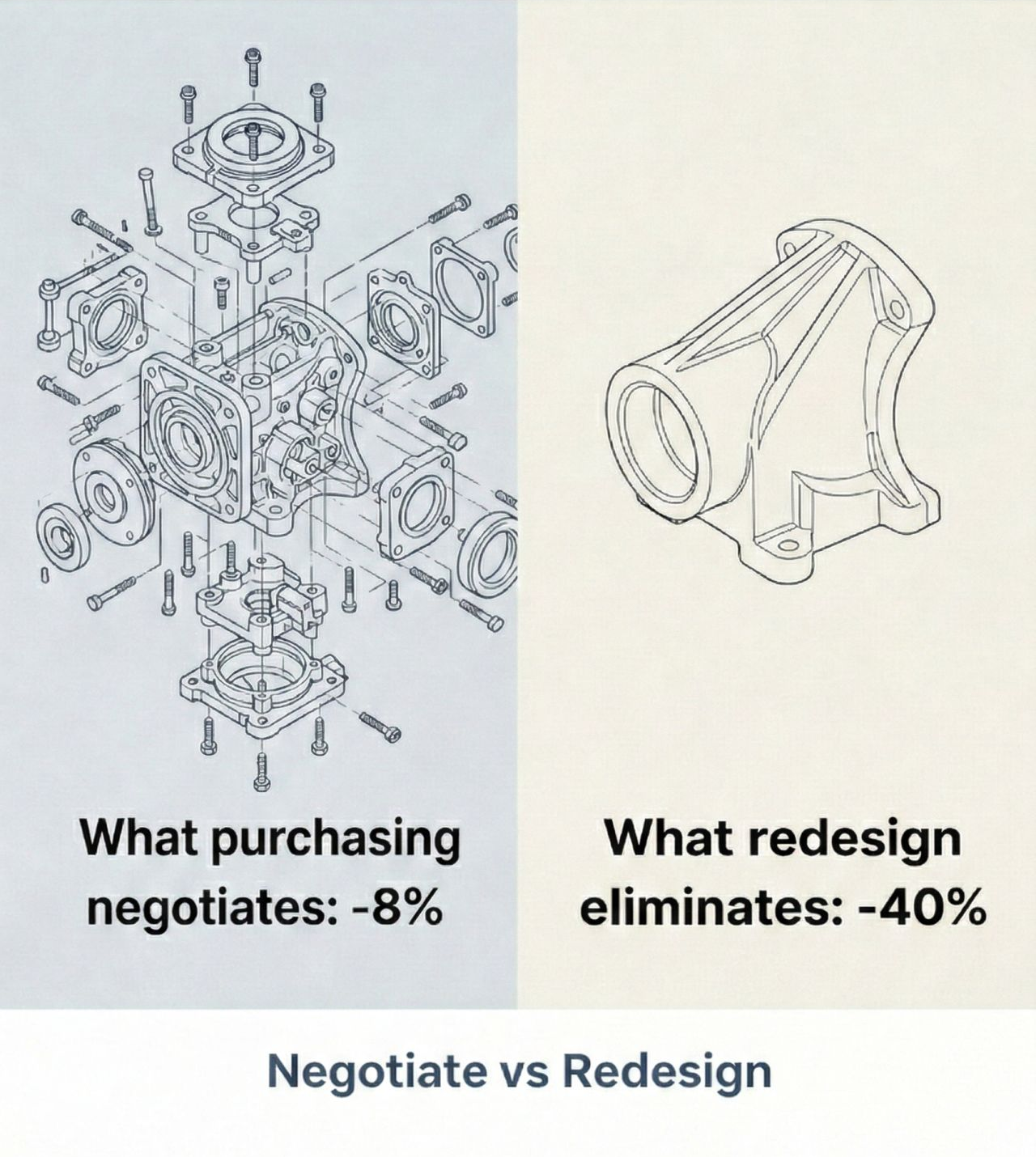
That 10% supplier discount your team fought for? It shaved pennies off a design that was never evaluated for cost in the first place. 70-80% of a product's manufactured cost is locked before an RFQ goes out. Supplier negotiations cannot fix a design problem. DFMA analysis can.
Your procurement team just spent eight weeks negotiating a 47-part electromechanical assembly. Three qualified suppliers. Detailed RFQ packages. Six weeks of back-and-forth. The quotes came back within 8% of each other, which the team took as proof that pricing was competitive.
It wasn't. The quotes were consistent because all three suppliers were pricing the same inefficient design. The consistency proved the suppliers agreed on the cost of the wrong architecture, not that the architecture was right.
This is the most expensive mistake in manufacturing that nobody talks about. Companies pour months into negotiating the price of a design while the design itself goes unquestioned. The supplier isn't overcharging you. They're pricing exactly what you handed them. The problem is what you handed them.
Why supplier negotiations hit a ceiling you can't negotiate past
When a request for quote lands on a supplier's desk, the cost is already mostly decided. Not by the supplier. By the engineering team that chose the material, specified the tolerances, set the part count, and defined the assembly sequence weeks or months earlier.
Research across thousands of products shows that 70-80% of a product's manufactured cost is committed by the time the design is on paper. That means procurement is negotiating the remaining 20-30%. Even a brilliant negotiation that captures half of what's left only moves the total cost by 10-15%.
Meanwhile, the design decisions that actually drive cost, part count, process selection, tolerance choices, and assembly complexity, were never questioned. Three quotes on the same flawed concept don't reveal what the product should cost. They tell you how three suppliers priced the same mistake.
If your product has 47 parts and 14 of them exist only to fasten, align, or connect other parts, no amount of supplier negotiation will fix that. Those 14 parts represent material, tooling, inventory, assembly labor, and failure modes that shouldn't exist. That's not a purchasing problem. That's a design architecture problem.
Where the real cost lives (and why procurement can't reach it)
Consider what actually drives the cost of a manufactured product. It is not the supplier's markup. It is the chain of decisions that created the part in the first place.
Part count. Every part in an assembly carries its own material cost, tooling cost, supplier management overhead, inventory carrying cost, incoming inspection, and assembly handling time. A product with 47 parts has 47 of everything. Reduce that to 19 parts and you don't just save on material. You cut assembly time, simplify the supply chain, reduce failure modes, and shrink the inventory footprint.
Process selection. A machined aluminum housing and a die-cast aluminum housing may perform the same function. But the machined version might cost $31.20 per unit at volume while the casting costs $8.40. That's not a supplier problem. That's a process decision made during design that procurement inherited.
Tolerances. Tighter tolerances cost more. Always. A tolerance of ±0.05 mm on a surface that only needs ±0.25 mm adds cost at every step: slower machining, higher scrap rates, more inspection. These decisions are buried in the drawing, and suppliers price them whether the function requires them or not.
These are all design decisions. They're made by engineering, locked into the drawing, and handed to procurement as fixed constraints. The supplier prices what they see. They can't redesign what they were given.
Shaving 4% off a supplier quote for a part that shouldn't exist in the first place isn't cost reduction. It's damage control.
What happens when you challenge the design instead of the supplier
The results are not incremental. When teams question the product architecture before locking the design, the savings are structural and permanent. Here's what that looks like across real companies.
At Beijing Automotive Technology Center (BAIC), the engineering team was preparing a new model of an off-road vehicle and knew the existing front support structure had cost and quality problems. The bumper assembly had accumulated parts over successive design generations: brackets, fasteners, alignment features, and interface hardware that nobody had questioned. A DFMA analysis identified part consolidation and assembly simplification opportunities throughout the structure. Fasteners were replaced with integrated attachment features. Separate alignment components were eliminated by redesigning the mating interfaces. The result was a lighter, cheaper, more reliable assembly for a vehicle built in high volume, where every dollar per unit compounds across the production run.
At CNH Industrial, a design team applied DFA analysis during the concept phase of a new tractor cooling package. The original design had 352 parts. The analysis identified 58 parts that could be eliminated through snap-fits, welds, and design integration, dropping the count to 294. Assembly time fell 18%. And the team caught all of this before any tooling was cut, which means the savings were locked in from the start rather than retrofitted later at five times the cost.
Those aren't outliers. At IDEXX, a DFMA-driven redesign cut part count by 83% and assembly cost by 38%. NCR Voyix reduced parts by 85% on a POS terminal and saved $1.1M in annual labor costs. Endress+Hauser credits over $1MM in savings to a company-wide DFMA implementation across their product portfolio. The pattern is consistent: the biggest cost reductions come from questioning the design architecture, not from negotiating harder on the existing one.
None of these savings were available through supplier negotiations. They were locked inside the design, invisible to anyone who wasn't asking whether each part needed to exist. That's the fundamental difference between design for manufacturing and purchasing-led cost reduction.
How DFMA software finds savings that supplier quotes can't reveal
The gap between what suppliers quote and what a part should actually cost based on its geometry, material, and manufacturing process is routinely 20-40%. Should-cost analysis built on DFMA methodology closes that gap by asking a different question.
Instead of asking "what will a supplier charge for this part?", DFMA software asks: "What should this part cost given its geometry, material, and the right manufacturing process?" Then it asks the harder question: "Does this part need to exist at all?"
That second question is the one procurement never gets to ask. And it's where the biggest savings live.
DFMA software works through a product systematically. For every part in the assembly, it asks three foundational questions: Does the part move relative to all other parts already assembled? Does the part need to be a different material? Does the part need to be separate for assembly or disassembly? If the answer to all three is no, the part is a candidate for elimination.
This is not abstract theory. It is a concrete, repeatable evaluation that engineering teams apply to real assemblies. The output is a redesign direction backed by cost data, not a vague recommendation to "reduce costs."
And there's an additional benefit most teams don't expect. When you run a should-cost analysis before the supplier negotiation phase, you know what each part should cost to manufacture. So when the quotes come in, you're not comparing three prices against each other and picking the lowest. You're comparing each price against an independent cost benchmark. You know whether the quote is competitive or inflated. You know which line items to push back on and which ones are already fair.
That changes the supplier conversation entirely. You're no longer hoping for a discount. You're negotiating with data.
The real cost reduction strategy starts before the RFQ
Supplier negotiations have a role. They always will. But they are the finish line of cost management, not the starting line. The starting line is the design review where someone asks: how many of these parts actually need to exist? What process gives us the best cost at this volume? Are these tolerances driven by function or by habit?
Those are engineering questions, not purchasing questions. And they need to be asked while the design is still flexible enough to act on the answers.
Pick your highest-volume assembly. Count the parts. Ask how many exist only to fasten, align, or connect other parts. If you don't know the answer, that's the first problem to solve.
Run the numbers on your most expensive product with the DFMA ROI Calculator to see what's actually at stake. If the design has never been challenged for cost, the gap between what you're paying and what you should be paying is almost certainly larger than any discount a supplier will ever offer.
Learn more about should-cost analysis, explore our approach to design for manufacturing and assembly, or talk with our team about running a DFMA analysis on your highest-cost assembly.