DFMA: SHOULD COSTING
 DFMA: PRODUCT SIMPLIFICATION


What is DFMA: Should Costing?
DFMA: Should Costing builds manufacturing cost estimates from the ground up: process cycle times, material consumption, machine capability, tooling, tolerances, and secondary operations. The result is a transparent, line-by-line cost build-up that shows why a part should cost what it does, not just that it does.
Explore alternative processes and materials, specify tolerances and surface finishes, and see cost results update instantly. As you select effective shape-forming processes and refine features, your design becomes cost-optimized. Every assumption is visible and editable, so engineering, sourcing, and suppliers can align around a single source of truth.
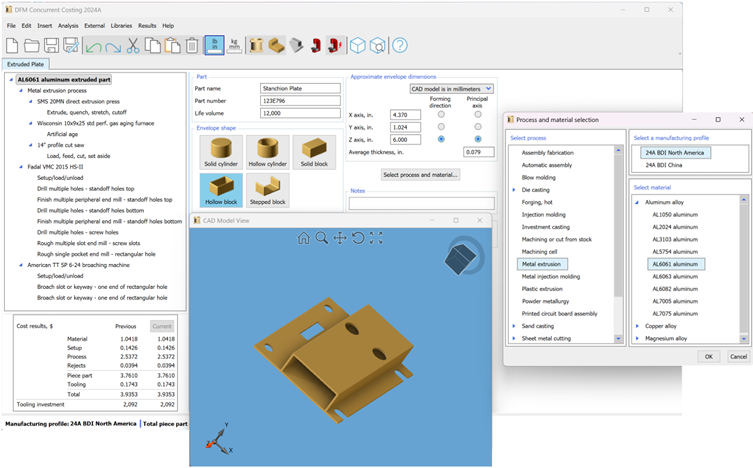
Build defensible should-costs and compare process alternatives in minutes.
How it works
Should Costing follows a structured workflow that delivers a defensible estimate in minutes, not days. Start broad and refine only where the numbers move.
Choose from 15+ process cost models: machining, injection molding, die casting, sheet metal, forging, and more. Each model includes pre-populated libraries for machines, materials, and operations.
Enter key dimensions, features, and complexity. Import from CAD (STEP, STL, IGES) to select cost-driver features directly from the 3D model, or enter parameters manually.
Select from thousands of material/machine combinations. Specify tolerances and surface finishes. Set production volume to see how unit cost scales with quantity.
See a transparent breakdown: cycle time, material, tooling, setup, secondary operations, and overhead. Every line is traceable and editable.
Swap processes, materials, or regions to see cost impact instantly. Use cost vs. life-volume graphs to find the crossover point between process alternatives.
Why teams choose Should Costing
Defensible Accuracy, Not Guesswork
Every estimate traces back to process mechanics: how long the cycle actually takes, how much material is consumed, what tolerances require secondary operations. Suppliers can see exactly what you assumed and challenge specifics instead of arguing about a total number.
Fast Time to First Estimate
Out-of-the-box libraries let new users generate credible should-costs in days, not months. Customize only where it matters.
Built for Concurrent Engineering
Introduce cost reality at concept and early design to align engineering, sourcing, manufacturing, finance, and suppliers. Every stakeholder sees the same cost model with the same assumptions.
Supplier-Ready Transparency
Share the specific inputs behind your estimate to drive collaborative, fact-based negotiations. No pressure tactics required.
Competitive Costing Without CAD
Benchmark what competitor parts should cost and evaluate make/buy and feature trade-offs even when drawings aren't available.
Global Cost Perspective
Compare should-costs across major manufacturing regions with consistent, pre-loaded country profiles. Powered by DFMA Global Costing Data, with 200,000+ regionalized data points across 22 countries.
The Dynamic Cost Agent
Not all inputs matter equally. The Dynamic Cost Agent identifies the specific parameters that have the largest impact on part cost and asks about those first. Instead of filling out every field in a cost model, you answer the few questions that actually move the number.
The result is a credible estimate with less effort and fewer rabbit holes. For complex parts with dozens of potential inputs, the agent focuses your time where it counts and skips what doesn't change the answer.
Global Costing Data — add-on module
Extend Should Costing across borders. DFMA Global Costing Data provides fully regionalized manufacturing cost inputs across 22 countries and 12+ processes: machine rates, labor, materials, energy, tooling, and tariffs. Switch regions with one click; every cost input adjusts to that country's profile automatically.
Frequently asked questions
How does DFMA should costing work?
DFMA: Should Costing builds estimates from process physics rather than historical averages. You select a manufacturing process, define the part geometry and key features, specify materials and tolerances, and the software calculates cycle times, material costs, tooling amortization, and secondary operations based on the actual mechanics of manufacturing. The result is a transparent, line-by-line cost build-up you can explain and defend.
What manufacturing processes does DFMA cover?
DFMA: Should Costing includes 15+ process cost models: die casting, injection molding, machining (turning and milling), sheet metal fabrication, hot forging, sand casting, investment casting, extrusion, blow molding, thermoforming, PCBA, foam molding, and more. Each model includes pre-populated libraries for materials, machines, and operations that can be customized to match your specific manufacturing environment.
What is the Dynamic Cost Agent?
The Dynamic Cost Agent is an intelligent assistant built into DFMA: Should Costing that identifies the specific inputs with the largest impact on part cost. Instead of requiring you to define every parameter upfront, it asks targeted questions about the features and dimensions that actually move the number, so you reach an accurate estimate faster with less effort.
How is DFMA should costing different from parametric estimating?
Parametric tools derive cost estimates from statistical regressions on historical data. DFMA builds costs from the physics of each manufacturing process: how long a cycle actually takes given machine capability, how much material is consumed given part geometry, what tolerances require secondary operations. The result is an estimate you can trace line by line, not a regression output you have to accept on faith.
Do I need CAD to use DFMA: Should Costing?
CAD is helpful but not required. DFMA: Should Costing can import STEP, STL, and IGES files to select cost-driver features directly from the 3D model, but you can also enter part parameters manually. Teams routinely cost competitor parts, early-stage concepts, and supplier quotes without CAD by entering dimensions, material, and feature counts directly.
See what your parts should cost
Bring a cost-critical part. We'll walk through a live should-cost analysis, build a defensible estimate, explore process alternatives, and show you exactly where cost hides in the design.